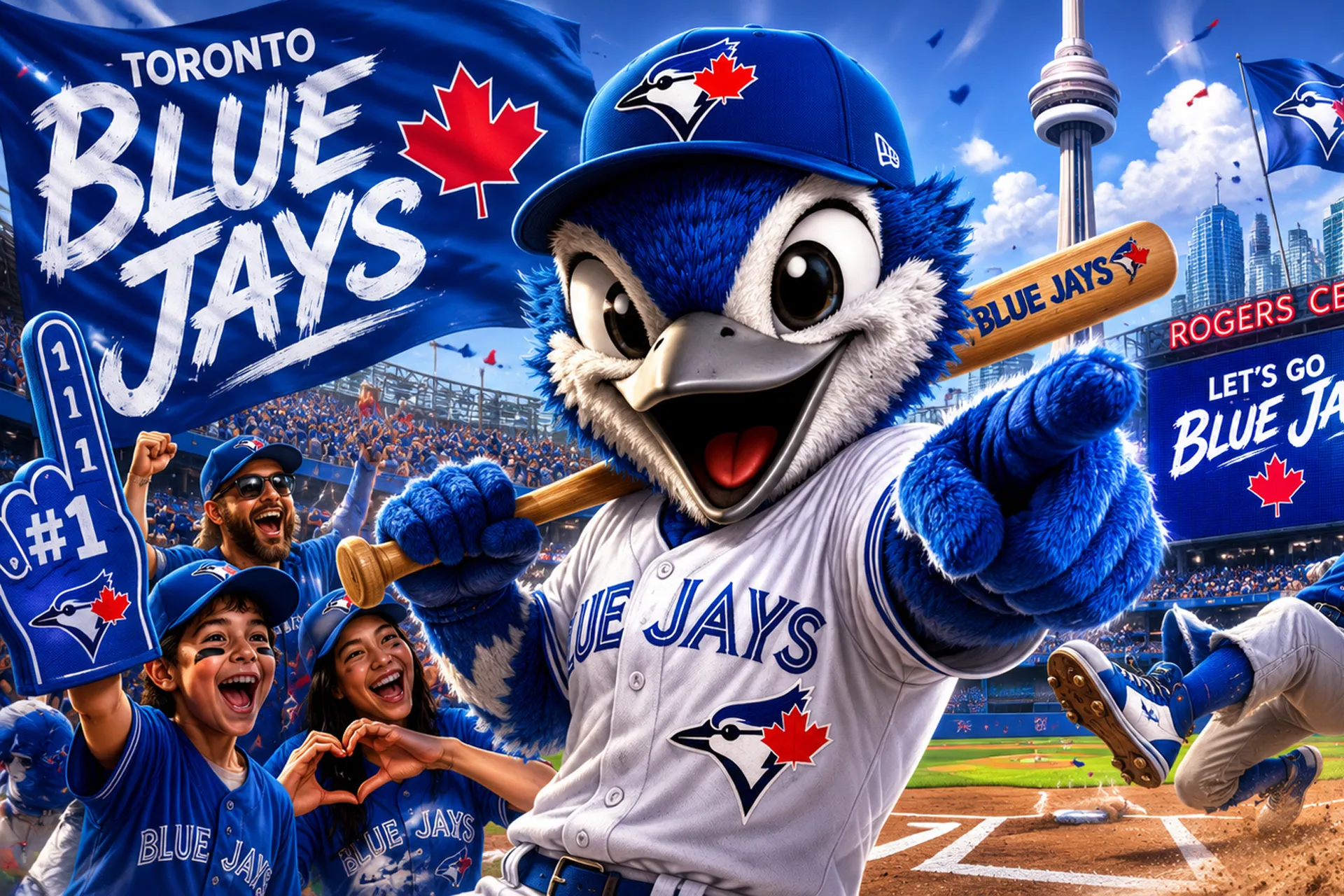
The AI Slopification of Sports Fandom
Blue Jays star Alejandro Kirk’s mother is dead. So is Kazuma Okamoto’s. John Schneider has cancer. George Springer opened a free hospital for the unhoused, but also came out in support of ICE. Vladimir Guerrero Jr. is feuding with Whoopi Goldberg while Mark Shapiro beefs with Greta Thunberg. Kevin Gausman paid the medical bills of 50 cancer patients. Braydon Fisher adopted 10 children. The front office is building a multi-million-dollar statue of Charlie Kirk outside the Rogers Centre. The FBI has raided Joe Carter’s home. The Blue Jays pickleball team’s jet crashed, leaving no survivors.
None of this actually happened. Yet stories like these circulate constantly through Blue Jays Facebook groups, reaching tens of thousands of followers. They’re generated at industrial scale by content farms and individual users as part of the broader proliferation of low-effort AI-generated content now widely known as slop. A blend of fake news, weird imagery and engagement bait funnels users toward scam-laden fake-news websites designed to harvest advertising revenue, collect personal information or facilitate phishing schemes.
One of the most notable examples is the “Shrimp Jesus” phenomenon, when bizarre AI-generated religious images including Christ-like figures composed of crustaceans flooded Facebook feeds. Slop ecosystems are a predictable consequence of platform enshittification, the process by which digital platforms gradually degrade as they optimize for growth, monetization and extraction at the expense of user experience and information quality.
I first encountered Blue Jays slop when a post from a fake Alejandro Kirk account denouncing gay marriage appeared in my feed. Curious about its origin, I clicked it—unintentionally signalling to the algorithm that I desired more slop. Soon my feed, already heavy with Jays content, was filling up with wild claims and surreal hallucinations. Across Facebook, dozens of groups with names like “Blue Jays Beat,” alongside fake player accounts, form an ecosystem that churns out a steady stream of slop into the feeds of an often credulous audience. Their existence is neither accidental nor organic.
Similar slop ecosystems surround every major sports fandom, where it seems like every star and team is gifting free season tickets to veterans or visiting their beloved fans in hospital. Deepfakes have emerged of Cristiano Ronaldo and Lionel Messi giving each other haircuts. European football clubs are beginning to take notice of the negative impacts that slop can have on their brand and players’ reputation, but their options to respond remain limited, so the slop continues to proliferate.
Related Posts
The Blue Jays Lost. So Did I.
Goodbye to Gretzky
Related: Why the Internet Is Worse Than Ever
A 2025 investigation by Agence France-Presse found that AI-generated content was widespread during the Blue Jays’ playoff run and was frequently amplified by content farms. AFP identified 32 Facebook pages posting baseball-related AI-generated content to a combined audience of 248,000 followers. According to Facebook’s page-transparency data, many of these pages were administered from Southeast Asia rather than by Blue Jays fans or local media outlets. Similar pages are still active, reacting to real and imagined storylines with fresh slop.
Much of the slop is banal, such as announcements that an athlete has gotten engaged or done some charity work. Some, however, is genuinely damaging. Although the Blue Jays were one of the first MLB teams to officially host a Pride night, slop posts about the players and front office taking homophobic and transphobic positions receive hundreds of likes and comments like “I think he picked up more fans” and “He is sofakin right.” Recent research from the University of Waterloo has shown that users could identify the difference between AI-generated and real images only 61 per cent of the time. For the feed-scrolling fan increasingly unable to differentiate between fact and fiction, the revelation of imagined homophobia will either affirm their bigotry or break their heart.
This is hyperreality: a simulation of sports fandom that gradually pollutes the thing itself, collapsing the boundary between reality and fabrication in one of the few cultural spaces many people still assume is real. Umberto Eco wrote his 1975 essay “Travels in Hyperreality” after a road trip through the United States, during which he developed a sense of discomfort with how eagerly Americans appear to prefer and accept the fake over the real. He pointed to Disneyland as a key example of how the real world, with all its inconsistency and ambiguity, struggles to compete with a version of itself that has been cleaned up and made convenient. The fake world quietly displaces the original altogether.
Live sports remain one of the few mass cultural experiences still rooted in physical presence, genuine unpredictability and collective participation. The Blue Jays’ 2025 World Series run demonstrated that power: the iconic home runs were really hit, the bars were really packed, the loonie dogs were really eaten, and a series of misplays really did deny Torontonians the communal experience of a championship parade. I attended Game 2 of the Blue Jays’ division series against the New York Yankees in early October, when the young phenom pitcher Trey Yesavage, in his post-season debut, racked up 11 strikeouts without giving up a single run. The experience of temporarily losing my mind with glee, hugging strangers while screaming into the sky, was transcendent. That realness in the face of creeping hyperreality is what makes sports matter, and is precisely what is threatened by AI slop.
Related: The Anti–Slop Music Resistance
For the average sports fan scrolling through this environment, the fabricated Blue Jays post sits indistinguishably among the rest of the constant stream of AI slop, just another item in a feed where the boundary between real and fake has already been softened. This undermines sport’s central premise: the fact that it isn’t fixed or contrived, that fans genuinely don’t know what happens next. That’s punctured when these raw moments are packaged into an endless virtual feed where nothing can be trusted. The implicit contract between sport and its audience begins to fray, as the fan is no longer a witness to something real, but a consumer of content that merely resembles it.
The spread of AI-generated athletes and sports media content is already visible across nearly every major sport outside of baseball. During the 2025 Super Bowl, Fox Sports broadcast a tribute to the coach and broadcaster Jimmy Johnson that included AI-generated elements. A Montreal Canadiens superfan account drew nearly 10,000 followers before users realized it was entirely AI-generated. ESPN is facing similar criticism after broadcasting an AI image of retired NBA player Tony Parker during the 2026 Championship.
Slop is also slipping into official team social media platforms. The Chicago Cubs have repeatedly posted AI-generated videos, the Atlanta Braves have posted AI-generated action figures of players, and the Colorado Rockies have posted an AI-generated image of a player making a diving catch. Fan reactions are generally negative, if not openly hostile and threatening.
AI slop on social media is far from the only way the line between fact and fiction is being blurred in professional baseball. Major League Baseball and several teams have been steadily experimenting with AI-powered fan tools and automated content production systems, while broadcasters are increasingly leaning on AI-assisted highlights, summaries and production workflows. A partnership between Google Cloud and MLB’s Statcast system introduced a generative AI tool that could predict, on screen, where a potential home run might land during Home Run Derby broadcasts. At the 2025 MLB Tech Summit in San Diego, a “GenAI Showcase” highlighted “real-world applications from MLB & clubs,” including the Rockies using AI-generated images from fan photos as a way to spark internal creative ideas.
Related: World Cup Mania
One of the weirdest and most hyperreal developments in sports is the recent agreement between the MLB Players Association and the AI firm Genies to create AI avatars of baseball’s biggest stars. Instead of an autograph session or encounter near the dugout, fans are offered the opportunity to ask a virtual star about an in-game decision or a recent home run. In turn they’ll receive a reply generated by a carefully constrained persona model designed to simulate the feeling of a personal interaction.
Fandom has always involved a layer of collective make-believe. The intense attachment fans feel toward an entertainment product and the sense of belonging in a stadium full of strangers wearing similar hats aren’t exactly grounded in reality, but they’re also not fake. They serve real emotional needs, even if the mechanisms are largely illusory. Even the most mediated forms of access retain some connection to an actual person existing somewhere beyond the screen. AI avatars replace that relationship with a simulation engineered to feel intimate while remaining entirely controlled, cynically taking advantage of the deeply human irrationality at the heart of fandom.
Outside of league- and union-sanctioned products and partnerships, AI slop is easily found across the vast networks of sports content creators, highlight clippers and alternative media outlets. Influencers and YouTubers use AI-generated images for logos and thumbnails, and team news aggregation websites publish generated text. Even long-established sports publications have succumbed to the siren song of endless cheap content. Sports Illustrated has faced AI-related controversies, and the program SportsCenter has posted baseball-related slop to its platforms.
Fans themselves bear some of the blame. A recent study from CNET found that 11 per cent of respondents actually like AI-generated imagery, and it’s not hard to find fans revelling in the slop. Facebook has many fan-orientated groups full of real people happily consuming and posting their own Blue Jays content, while on other platforms rival fans post deepfakes and shitposts of hated players making wild and reputation-sullying comments. Recently, a strange social media trend has emerged in which social media users use AI to produce fake candid videos of themselves at a baseball game. The trend has made it from Korea and China to North America, and fans are now pumping out their own versions set in the Rogers Centre.
Related: The Blue Jays Lost. So Did I.
A 2025 study in the International Journal of Sport Communication found that individuals were far more likely to share both human- and AI-authored articles if they engaged with their favourite teams, and that the distinction between the two didn’t have a significant impact on perceived credibility. It makes intuitive sense. Sports fandom is particularly vulnerable to AI manipulation due to its parasocial dynamics and the overwhelming desire for a never-ending feed of content. Teams have understood this for years, which is why their social media operations have grown so aggressive about feeding the machine. The problem is that no matter how much content gets produced, the appetite is never satiated.
Sports fandom was not perfect before it was slopified. The attention economy had already filled fan feeds with clickbait, engagement bait, fake rumours, misleading photoshops and toxic comment sections. But for all its flaws, there was still an expectation that the players, quotes and events being discussed were real.
Not anymore. For a fan now scrolling social media, AI slop functions as a barely differentiated, unregulated extension of the already engagement-seeking and tabloidesque sports media ecosystems. The threat it poses to fan well-being is tangible: fans of the Atlanta Braves have already been targeted by scammers using AI-generated images and videos of their favourite players, including one fan who thought she was donating $2,000 to a Brave facing money problems.
The slop farms, content creators, league offices and players unions are not the same beast, but they are feeding the same appetite, which itself drives fan slop production and engagement. Some are predatory and extractive, others promotional and profit-seeking, but all are staking their returns on fans who want more of their team than reality can supply, and who desire increasingly frictionless experiences. MLB’s engagements with AI don’t yet produce misinformation in the way a slop farm does, but they normalize the same underlying transaction: a simulation of connection with players and the game substituted for the real thing. Every official AI product that simulates reality makes the ecosystem a little more hospitable to the slop that exploits it.
In 2023, when AI generation was still a novelty, a grotesque and surreal advertisement for the Blue Jays generated by a TSN staffer went viral for its nightmarish and obviously artificial imagery. Since then, AI image generation has become more convincing, pushing sports fandom deeper into hyperreality. The experience of sports fandom is increasingly mediated by generative AI, undermining what makes spectator sports valuable to begin with. The appeal of fandom has always rested on the fact that the game isn’t scripted. A home run either clears the fence or it doesn’t. A team either wins or loses. However much synthetic content accumulates around the game, the game itself remains real. The farther everything else drifts into hyperreality, the more valuable that becomes.
What did you think of this story? Send a comment for publication to letters@macleans.ca, and supply your name and address. Comments should be fewer than 200 words, and may be edited for length and clarity.
Related Posts

The True Cost of Competing in the Olympics
The World Cup Will Relegate Canada to the Sidelines

Teresa Resch Is Calling The Shots
Get the Best of Maclean’s straight to your inbox.
Sign up for news, commentary and analysis. Join 60,000+ Canadian readers.