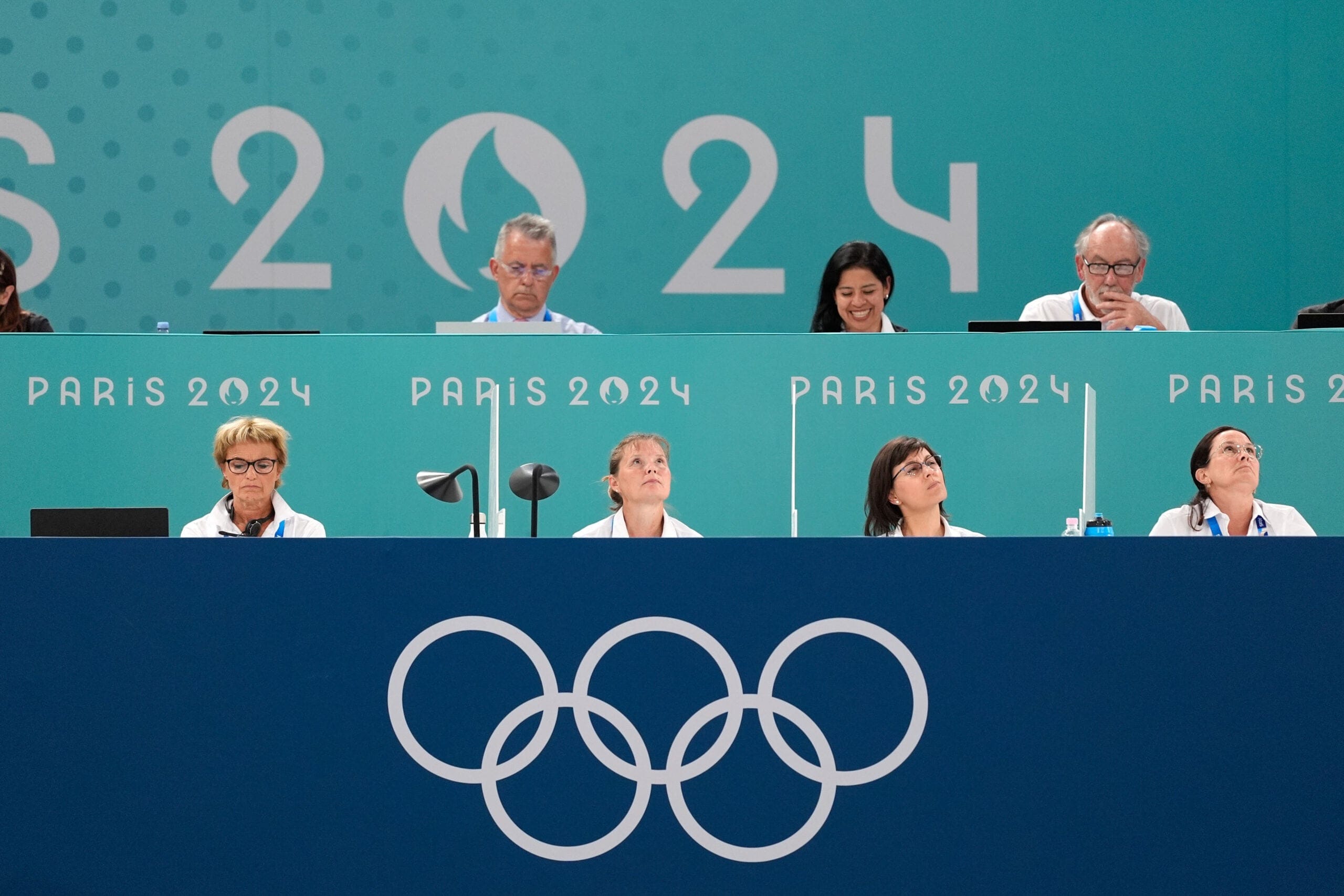
Could AI Judge the Olympics?
When fans walk into Toronto’s BMO Field to attend Canada’s first World Cup match this summer, the action on the pitch will look familiar, but something revolutionary will be underway. Embedded inside the official Adidas match ball will be a sensor chip that captures real-time data and feeds it directly into a video system designed to assist the referee on the field. Every touch is logged, including contact with hands and arms that shouldn’t touch the ball. Where once refs were forced to rely on their visual memory of the play, this data will help them call ambiguous plays with more precision. The result is greater accuracy, faster calls and fewer stoppages, with technology supporting referees rather than replacing them.
This hybrid approach is becoming the template across elite sport. In professional soccer leagues around the world, AI-assisted systems are routinely used to litigate objective events, like if a ball crossed the goal line or a player was offside. More subjective decisions like calling fouls still rest with human referees, but even those are increasingly informed by the data these systems provide.
Across disciplines, researchers are exploring how AI can be used to improve fairness in judging, make talent discovery more consistent and update training regimens. Last year, the X Games teamed up with Google Cloud to test out an experimental AI judge, which unofficially scored snowboarders in the halfpipe event. The gymnastics world championships have used a form of AI judging software since 2019. The system’s “eyes” have been upgraded from lasers to high-definition cameras, which compare the athlete’s routine to a database of positions and rulings. The program then produces a score with about 90 per cent accuracy.
Tennis offers a clear example of where AI can help with fairness. For decades, human line judges were part of tennis’s visual identity, crouching, staring and yelling from the sidelines. But they were also prone to error, particularly as the sport got faster. The difference between winning and losing a tennis match could hinge on whether a ball was judged a millimetre in or out. Players called for technological assistance, and in came Hawk-Eye, a computer-vision system launched in the early 2000s. Using an array of high-speed cameras to track a ball’s trajectory, Hawk-Eye could instantly determine whether a shot landed in or out, with greater precision than the human eye.
Related: AI Could Save Canada’s Health-Care System
Over the past two decades, Hawk-Eye was gradually phased into tennis tournaments, but resistance remained at the highest levels of the sport. Some governing bodies, particularly at tradition-oriented events like Wimbledon, worried that technology would erode the human element of officiating and the drama it provided. But calls for the adoption of Hawk-Eye grew louder, particularly as some players noticed patterns in human error.
Coco Gauff, a Black player in a predominantly white sport, became one of the loudest advocates for the universal use of Hawk-Eye after several disputed decisions went against her. That included a controversial ruling at the 2024 French Open and another at the 2024 Paris Olympics, where Hawk-Eye was not in use. In Paris, a line judge incorrectly called a shot by Gauff’s opponent out, disrupting play and causing Gauff to send her return into the net. The umpire overruled the out call, but counted Gauff’s shot; she lost the point and, eventually, the match. Many claimed that the debacle could have been avoided altogether if Hawk-Eye had been in place. The last few holdouts in the tennis world have been listening. Wimbledon introduced Hawk-Eye last summer, leaving the French Open as the only major tournament yet to fully adopt the system.
AI’s potential impact is even more pronounced in judged sports, where a lot more is up to interpretation. Across these sports, a common principle is emerging: let humans judge creativity, and let machines handle the technical facts. In figure skating and gymnastics, for example, athletes are scored using criteria that blend objective technical execution, like how many times they spin, with subjective aesthetic judgments, like their composition and use of music. Research has shown that human judgment in sports carries inherent error, shaped by experience, training and values. AI systems could improve objectivity by enabling judges to track measurable elements like rotation or impact force, while still leaving the subjective elements of artistry and expression up to the humans.
In practice, this should free judges to focus more fully on the creative parts of a performance, instead of trying to track granular technical details at full speed. It’s not a perfect system—there can still be bias in the subjective judgements, but in many ways, this is a continuation of a shift that was already happening. Video replay systems have been used to review close calls for decades. AI-assisted judging represents the next step in that evolution, so that the original call is accurate, instead of relying on a correction after controversy has already erupted.
AI tools are also being adapted for training. At a recent U.S. figure skating camp, developers of OOFSkate, a new AI-powered training app, showed off what the tech could do. Skater Andrew Torgashev appeared to land a four-revolution jump, but the computer’s video analysis showed he was a quarter of a rotation short, the kind of margin that can separate winners from losers at the elite level. That feedback allowed him to adjust his technique immediately.
Another consequential application of AI in sport will be talent identification: who gets recruited and who gets written off. That process shapes the future of competitions like the FIFA World Cup. When recruitment is biased, those biases travel up through the leagues.
Bias enters talent identification at the initial moment of recognition, when a scout decides whether a player is worth flagging at all, and again later on, when that player is weighed against others. A scout who’s a former player might favour athletes who play with a style similar to their own, while another could be naturally more interested in traits that are popular in a particular league or country. Other factors can creep in as well—things entirely unrelated to ability, like an athlete’s marketability or appeal to sponsors.
In 2024, my colleague Louis-Etienne Dubois and I worked with a North American professional men’s soccer team on an experiment to probe a deceptively simple question: how could AI help build a championship team? Prompted by the team’s scouting department, the project was framed as an opportunity to improve talent identification and recruitment by reducing their potential biases. The concern wasn’t overt discrimination, but something subtler—the accumulation of small, often unconscious preferences that influence decision-making.
We showed the team’s scouts 15-minute clips from three real games: one from North America’s Major League Soccer, one from Germany’s Bundesliga and one from an NCAA match in the U.S. First, they watched standard broadcast footage. Then they viewed the same clips processed through an AI computer-vision system. The crowd and advertising were removed, as well as the athletes’ body type, skin colour and even gender cues. Players appeared as anonymized stick figures moving across a green field, labelled with random numbers.
Scouts were asked to evaluate midfielders on four criteria commonly used in professional recruitment: technical ability, tactical intelligence, physiological attributes and perceived fit with the organization. It was, in effect, a version of The Voice, applied to soccer scouting, where performers are judged on what they do rather than who they are, and their identities are revealed only after the assessment is made.
The scouts’ assessments were still highly sophisticated, even without visual cues. But when they couldn’t make assumptions about body type or background, they focused more on players’ decision-making, positioning and game intelligence. The results suggested a real possibility of reducing bias at the earliest stages of talent identification by making scouts more aware of how context shapes their perception.
This approach builds on an older idea. Data-driven decision-making in sports entered the mainstream during the Moneyball era of the early 2000s, when baseball teams realized that long-held beliefs about what made a good player—things like pedigree or physical build—were not always supported by the data. The insight was simple but disruptive: when you look closely at the numbers, you often find value where prejudice told you there was none. AI represents the next iteration of that logic, applied to vastly richer datasets.
The potential benefits extend to virtually any sport. American football offers a stark example. For decades, quarterbacks were overwhelmingly white, not because talent was absent elsewhere, but because entrenched systems and expectations shaped who scouts saw as a natural fit for the position. It wasn’t until 2023 that both Super Bowl starting quarterbacks were Black. AI-assisted talent identification could help surface overlooked skill sets earlier, widening the pipeline and reshaping who gets opportunities.
For all its promise, AI will not eliminate error or bias from sport. In officiating, systems like Hawk-Eye are fallible. They occasionally get calls wrong, just as human line judges do. The difference is that when a machine makes an error, it leaves a trail of data that can be examined and corrected, so the system can be refined and improved. We have to keep an eye on how any technological intervention affects athletes and their field of play, but in tennis, at least, players and fans have adjusted and accepted and systems have become faster and more reliable.
When it comes to wider adoption, governance is still the most significant challenge. Governments worldwide are grappling with the implications of misinformation, deepfakes and automated decision-making. The sporting world is currently awash in startups promising revolutionary tools, many of which remain unvalidated. What comes next is not faster adoption, but careful testing, rigorous auditing and responsible scaling.
Similar caveats apply to the use of AI in talent identification. The biggest risk is algorithmic bias. AI systems learn from the data they are fed, and if that data reflects historical inequities, those inequities can be reproduced at scale. Bias can also enter through design choices: which attributes are measured, which are ignored and how performance is weighted. AI is not a moral actor, and without careful monitoring, its outputs can be interpreted or emphasized in ways that reinforce existing power structures. That is why human judgment should not disappear in AI-assisted scouting. Instead, AI can be used to make human judgment more visible and more accountable.
Laurel Walzak is an associate professor of sport media at Toronto Metropolitan University and founder of the Global Experiential Sport Lab.
Related Posts

The World Cup Will Relegate Canada to the Sidelines

The True Cost of Competing in the Olympics

The Blue Jays Lost. So Did I.
Goodbye to Gretzky
Get the Best of Maclean’s straight to your inbox.
Sign up for news, commentary and analysis. Join 60,000+ Canadian readers.