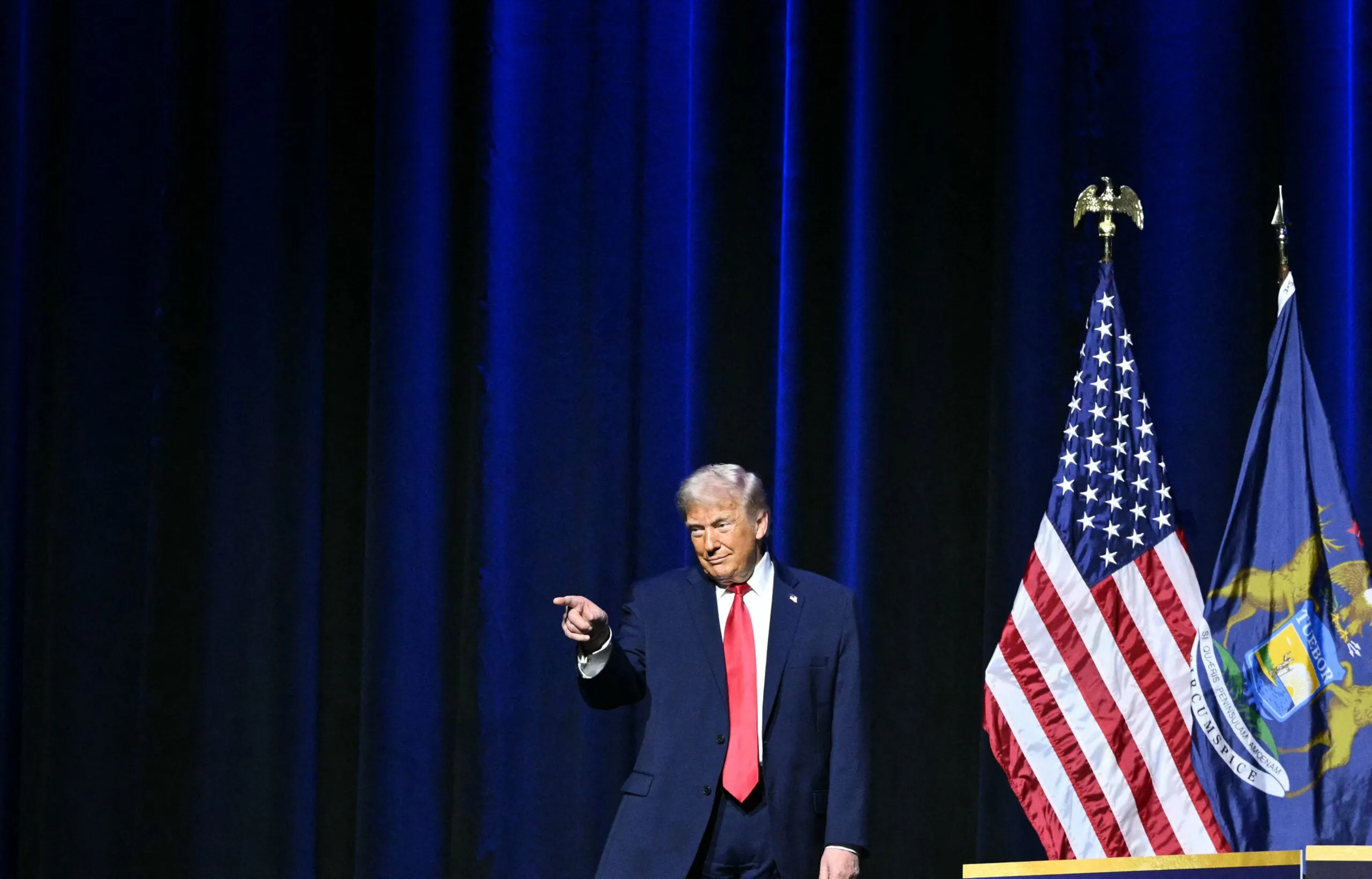
Trump Wants the Western Hemisphere—Canada Included
In early December, the Trump administration unveiled a new national security strategy. It called its new policy the “Trump Corollary” to the Monroe Doctrine, President James Monroe’s 1823 declaration of U.S. supremacy in the Americas. That month, I was in Lima, Peru, working with political scientists on a project to help voters evaluate presidential candidates. We’d watched the erosion of democracy in the U.S. and Latin America with alarm, and we didn’t know what to think. Was this bombastic rhetoric or a return to the long history of U.S. intervention in the Western Hemisphere?
The answer came swiftly, of course, when a U.S. military operation dubbed “Absolute Resolve” captured Venezuelan dictator Nicolás Maduro and his wife Cilia Flores and spirited them to New York to stand trial. At a press conference the same day, Trump was asked the obvious question: who, now, was in power in Venezuela? “We’re gonna be running it,” he replied. He added that the U.S. would “rebuild the oil infrastructure,” and would be “getting back the oil that was stolen from us.” Seemingly, the Monroe Doctrine was back—with a vengeance.
The Monroe Doctrine declared that the United States would regard any attempt by European powers to “extend their system to any portion of this hemisphere” as a threat to U.S. security. Framed as a defence of republican government against monarchy, it claimed the Western Hemisphere as a sphere of influence. The imperialistic implications were even clearer in Theodore Roosevelt’s Corollary of the Monroe Doctrine in 1904, which arrogated to the United States “international police power” to justify intervention in Santo Domingo (1904), Nicaragua (1911) and Haiti (1915). Harvard historian John H. Coatsworth estimates that between 1898 and 1994, the U.S. intervened to change governments in Latin America at least 41 times—roughly once every 28 months in the 20th century. And despite the lofty statements to the contrary, U.S. intervention has rarely supported democracy.
Related: Why America Can’t Conquer Canada
Trump’s strategy is the Roosevelt corollary on steroids. It expresses the same paternalistic view, but with a focus on preventing mass migration, using military force against transnational crime and drugs, a carte blanche to ensure the Western Hemisphere is free from foreign ownership of strategic assets and locations and ensuring U.S. control over critical supply chains.
In the past, Canadians felt impervious to the threat of the Monroe Doctrine. And, for what it’s worth, Canada is scarcely mentioned in the 2025 National Security Strategy. But Trump’s designs on Greenland—based on the claim that the U.S. must prevent Russia and China from using it to gain access to the Arctic—suggests that the Monroe Doctrine now extends northward, giving the U.S. dominance from Alaska to Tierra del Fuego and everything in between. If Trump wants to bring back imperialism, we’re facing a potential threat to our sovereignty, our borders, our lakes and water, our oil and critical minerals, our defence capabilities and our democracy. Canada is part of the Western Hemisphere and we can’t presume to be immune to intervention.
Trump has already threatened to use economic force to get rid of “that arbitrarily drawn line” (the 49th parallel). Some fear he will tear up the agreements governing the Great Lakes and the Columbia River. He’s withdrawn from dozens of international agreements; what’s to stop him from aggression against Canada?
If the U.S. goes down this path, it could move Coast Guard icebreakers through the waterways of the Northwest Passage to contest Canadian claims to Arctic sovereignty. It could fund and recognize the independence movement in Alberta in an attempt to divide Canada and improve access to Alberta’s oil. It will insist on Canadian subservience to the U.S. military through procurement and participation in the Golden Dome, a space-based missile defence system. Any favours toward China or limitations on U.S. foreign investment may be viewed with hostility, as we saw in the angry reaction to the attempt by Canada to tax U.S. tech giants.
Related: How Migrants Cross Trump’s U.S.-Mexico Wall
The Canada-U.S.-Mexico Agreement, or CUSMA, is up for renegotiation this year, and Trump will almost certainly use the talks to try to rewrite the rules of our trading arrangements, going after the remaining protections for Canadian businesses like supply management in dairy, eggs and poultry. He doesn’t want cars made in Canada. He may demand that Canada end its diplomatic ties with Cuba; after all, a key goal of the intervention in Venezuela was to cut off the supply of oil to the island. Such demands would now be backed with the implicit or explicit threat of force. In a world of spheres of influence, Canada will be unable to rely on the protection afforded by a rules-based multilateral order.
Canadians will be profoundly affected by Trump’s aggressive unilateralism. With threats of tariffs backed by diplomatic bullying, the United States will to try to block efforts by the Canadian government to diversify markets, to build up capacity to mobilize resources independent of the U.S., to procure goods (including defence contracts) that provide us with independent capabilities, and to protect our sovereignty in the Arctic or the digital space. It will hamper our ability to regulate AI and to create alternatives to the dominance of U.S. tech firms. It will cause economic disruption and volatility in our markets, potentially making us both poorer and more dependent.
The hope for Canada lies in the very misfortunes the Trump administration has created for the American people. Malignant narcissists intoxicated with power tend to come to grief through their own folly. Trump will inflict such harms on the U.S. economy, society and polity—including a massive increase in the national debt to benefit billionaires, rising cost of living due to tariffs, job losses, loss of tourism and a loss of competitiveness—that blowback from his multiple missteps will likely catch up to him. For instance, as Trump doubles down on oil, the global economy, with China in the lead, will continue its shift toward clean energy—leaving the United States behind. China is also likely to gain ground in multiple high-tech sectors, possibly including AI—where the U.S. has created a speculative bubble. Few leaders have cast aside so many advantages in favour of the hollow promise of personal power and might-makes-right politics.
Canadians should play a game of patient resistance. While awaiting the Trump administration’s inevitable implosion, we must quietly do the opposite of what it wants. We must hold firm in CUSMA negotiations and be prepared to walk away. We’ll need to diversify trade and investment, including closer ties with China and India. We must develop alternatives to the misinformation sewers running through X, YouTube and other social media sites based in the U.S. Most importantly, perhaps, we must create a new, genuinely sovereign defence strategy involving civilian mobilization, and procure weapons outside the United States.
Related: How to Fight Back
Our security ultimately depends on the restoration of the rule of law and the preservation of pluralist democracy in the United States. Democratic backsliding does not always lead to the breakdown of democracy. Canada must be an ally to the small-d democratic forces within the United States, even as we call out and resist the forces of Maple MAGA at home (notably, the Alberta independence movement).
Above all, we must remain strong and united against fascism and imperialism. There is unity to be found in this moment, as Canadians across the political spectrum find common cause in rallying against the threat from the south. The post-Freedom Convoy polarization that propelled Pierre Poilievre to a commanding lead in the polls has given way to a rally-around-the-flag moment for Canadians, bringing politicians as diverse as Doug Ford and Mark Carney closer together, with a centripetal force strong enough, perhaps, to bring even Danielle Smith into the Team Canada orbit. Such unity is crucial. Canada is on the frontlines of the resistance. We should prepare to pay a heavy price, but the cause is worth it.
Maxwell A. Cameron is a professor in the Department of Political Science at the University of British Columbia and the president of the global Latin American Studies Association
Related Posts
Carney Is the Crisis Manager Canada Needs
My Adventures in Greenland
Alberta Treaty Law Could Decide the Arctic
Carney’s Biggest National Project is Mythmaking
Get the Best of Maclean’s straight to your inbox.
Sign up for news, commentary and analysis. Join 60,000+ Canadian readers.